The design system of your life
Learn how to use Brad Frost's Atomic Design as a coaching lens for examining your life, from your foundational values up to the irreplaceable page that is you.
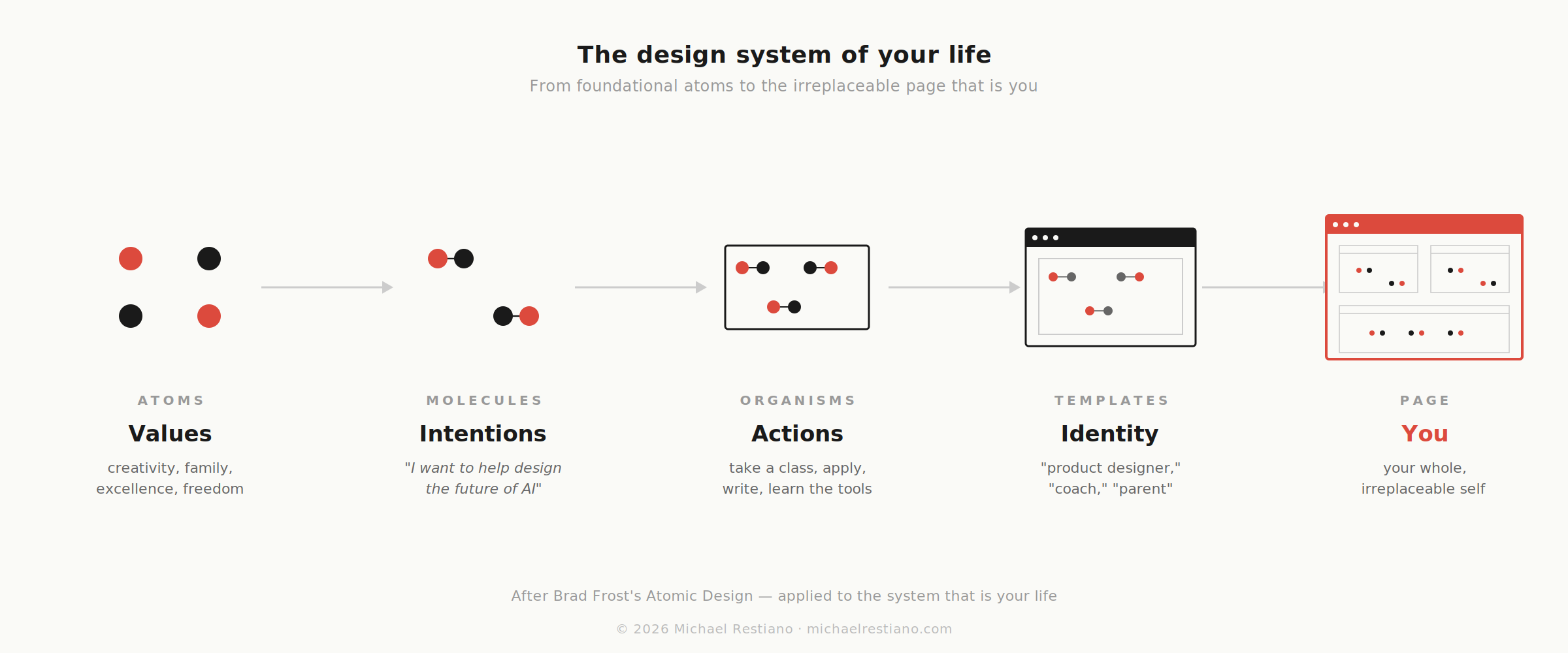
The funny thing about being a content design leader by day and a coach by night is that you can't help but see your clients the way you'd see a digital product — as a layered, nested system. A bunch of small parts assembled into bigger parts, again and again, until you get a beautifully unique human.
When I work with clients — even non-designers — my inner systems thinker loves to help them see how this big, resplendently ugly and horrifyingly beautiful thing called "your life" can actually be broken down into individual parts that influence each other up the chain.
In fact: I find that's the best way to do coaching work. Because talking about just the big picture, capital L life, can feel so amorphous and overwhelming for folks. Zooming in to the specifics can be deeply rewarding and incredibly valuable. Frankly, it's why so many people hire coaches in the first place.
But I'm all for a free resource, so here you have it! Here's how I view the design system of Life, using the language from "Atomic Design" by the inimitable Brad Frost.
Your values are your atoms
If we dissected your life down to its most atomic level, we'd find your values.
Values are single-word nouns that answer a deceptively simple question: "What's important to you in life?" Some of the most common ones I hear from clients are: creativity, family, excellence, excitement, growth, freedom, service, and beauty.
The entire system that is your life is built up from these foundational, atomic values. These are your buttons, your links, and your text blocks.
And I'll be honest — value discovery is some of the most spiritual work I do as a coach, because there's never a clear answer about why a certain value is present. It just is. The same way many of us seem to pop out of the womb with innate talents and interests, we also pop into life with a list of things we care about that gets forged and refined as we grow into adults.
By the time you're an adult, though, it's rare to see a value actually change. You might change the word you use to describe it. You might uncover a totally new one you'd never named before. But it's pretty rare for a client to look at me and say "ehh, this thing doesn't matter to me at all anymore." The same way you'd never really throw away buttons in your design system, but you may rebrand them.
So when your life begins to feel stale, stuck, wrong, or just plain not fun — very often we have to zoom into the atoms and look at what's not being respected.
For example, if you value creativity and you haven't made art in the last year, it makes sense that your life may have started feeling like a bowl of plain oatmeal. Or if you value family and you live very far away from them, then it would make sense that you frequently feel lonely or abandoned.
When in doubt: start with the atoms. I see this time and time again in my practice. I'll help people discover their list of atoms, and we'll find that at least half of them aren't currently being fulfilled.
The goal isn't to honor every single value every day — that's a lot to ask. But we sure do want to try. The most radiant people you know are that way because they're living lives that are largely value aligned. It really does all start here.
Your intentions are your molecules
The same way a search bar molecule is just the combination of two atoms — a button and an input field — you can think of an intention as a combination of your values, expressed in plain language.
Values answer the question "What do I care about in this world?" Intentions answer the question "With that in mind, what do I want to experience in this world?"
That may seem simple on the surface, but there is a real art to crafting intentions. And it is incredibly easy to confuse an intention with its evil cousin — an outcome.
You probably already know what an outcome is, especially if you work in a corporate space. It's a specific, measurable, definable thing that happens on a timeline. Our capitalistic culture is obsessed with outcomes because they're measurable and monetizable. The translation of outcomes into the personal development space gave us goals, which you've been hearing about since elementary school. Or any time you've cracked open a self-help book.
Here's the problem with outcomes and goals as the foundation of your life:
They assume you have control over life, when in fact you do not.
A very specific personal outcome might look like: "I am going to get a product design role at an AI-native startup by August." Nothing wrong with wanting that. But notice how specific it is? Notice how much of it actually depends on the whims of life rather than your effort?
What if the market is terrible? What if these companies don't have product design roles open right now? What if they don't start hiring until October? What if the role you'd be perfect for goes to an old college friend of the hiring manager?
Making outcomes our molecules sets us up for failure, because we're misreading how this whole thing actually unfolds. We're gaslighting ourselves into believing we have power we don't actually possess — and then getting furious when life doesn't cooperate, because it "should have." Or, alternatively, we do get the thing we want and we slowly become insufferable, convinced it was nothing but our brilliant efforts that pulled it off.
I spend a lot of my coaching work — especially with tech workers — clarifying this difference. I know it's jarring. It's probably not what you're used to. But I want you to see that life moves based on intention, not outcome.
Intentions are broader. They're open to interpretation. They leave room for life to fill in the blanks. In our example above, the underlying intention is probably something like "I want to help design the future of AI." When we take out the specifics, suddenly this job seeker is open to a whole bunch of opportunities they would've missed because they were laser-focused on the wrong target.
Since this is new territory, I'd lovingly invite you to try this with some goals you've been carrying around. Try to excavate the wish or desire underneath the specific thing you've been telling yourself you want. When that wish becomes a molecule in your life's design system — what becomes possible?
Your actions are the organisms
Molecules on their own don't make for much of a digital experience. Nobody ever came to a website because they loved the search bar. Molecules need to be assembled into component-like organisms in order to bring function and delight.
Life's equivalent of an organism is the actions you commit to — derived from your intentional molecules.
Let's take our designer from above with her new intention to help build the future of AI. If I were coaching her, one of my first questions would be: okay, how do we start making this intention manifest? How do we make it reality?
She might say things like — take a class on AI-native design. Dedicate a few hours a week to learning the latest tools. Apply to two or three roles per week that seem like a genuinely good fit. Start a Substack about her opinions on how AI is reshaping the design discipline.
If you're reading this, you're probably no stranger to action. To-do lists, OKRs, sprints, the whole bit. But here's what's important to remember:
These actions are created from an intention, which is created from values. There is a clean receipt line all the way back to what this person actually cares about in life. Which means these actions won't feel like chores. They won't feel like something she's dragging herself through.
I'm sure you've had the opposite experience. There's a task on your to-do list and you cannot for the life of you bring yourself to do it. Or you're doing something regularly — a hobby, a job, a relationship — and it feels like an absolute slog. We call this dissonance. The opposite of resonance, which is what something feels like when it lights you up.
I'd be willing to bet that if you put a microscope under those dissonant tasks and inspected their molecular and atomic components, you'd find things that don't actually belong to your life's design system.
Values that are actually your parents'. Or your partner's. Or that older sibling whose approval you've been chasing since you were eight. Intentions that aren't intentions at all because they're masquerading as outcomes you can't actually achieve. Or cultural intentions you feel like you should ascribe to — "I want to become really wealthy." "I want to live in a brownstone in Brooklyn." "I want to be the kind of person who runs marathons."
Many of us end up in lives that feel painful because we're trying to build them with components that don't actually work because they're built on inauthentic molecules and atoms.
Your identity labels are your templates
If you've ever had to do a "Who am I" slide for a work presentation, the things you'd put on that slide are your templates.
"I'm a product designer." That's a template — an identity. That identity is made up of a bunch of different organisms (actions) that you hopefully chose based on a few intentions (molecules) that map back to a set of core values (atoms).
These are called templates because other people can usually understand them quickly. When someone tells me they're a product designer, I have a rough sketch in my head of how they spend their time, what they're probably good at, and what some of their values might be. That gives my brain a quick reference point for how to view them and their work.
This is the benefit of creating specific identities. It is also, ironically, one of the dangers, because we start to assume that there is a "right" way to do a particular identity template. And we start comparing our templates to others and try to measure them.
That looks like assuming your product designer template must look exactly the same as that Twitter-famous product designer you follow. The entire act of personal comparison is, effectively, looking at one template from your life, holding it up next to someone else's, and squinting to see if yours measures up. If yours is "right" enough. If yours is "good" enough.
Speaking from my own life — there is a template to being a gay man in New York City. There is a template to being a life coach. There is a template to being a content design leader. These templates are created through shared experience and shared understanding, and they're useful. But you must always remember that while templates may look alike, they always belong to unique systems.
Translation: I am not you. And you are not them. Identity is a quick, conceptual shortcut for the mind but it is fleeting and ephemeral. You don't go to a website to admire its templates — you go for the overall experience.
My content design leader template is not going to look exactly like another content design leader's. And one of the worst things I could do for myself would be to try to copy theirs because I believe they have it "right" or because "that's how it's supposed to look."
There's nothing wrong with using other people as role models. But for any template to feel resonant and authentic, it has to be assembled from your design system — your values, your intentions, your actions. Otherwise, you'll end up living a flimsy imitation of someone else's life.
Which brings us, finally, to the top of the system.
The page itself is you
You probably saw this one coming.
You are your own unique little webpage in this massive website called life. There is never going to be a page out there that looks exactly like yours, because the underlying system is unmistakably, irreplaceably, yours.
And that is damn cool. Worth celebrating, really.
So what's the danger at this layer? I won't go too deep into non-duality in this post (there's plenty of other reading on the topic if you're curious), but the primary danger is mistakenly believing that you, somehow, are not a webpage. That you're actually something different. Something separate from the overall website. Something other than what everyone else is.
There are folks among us who think their design is so unique and so cool that they walk around believing they're superior to all the other webpages they share life's site with. And conversely, there are folks who believe their design is shit. Worthless. Maybe even meaningless.
Both camps are horribly wrong. And both perspectives result in intense personal suffering — just in different flavors.
What's crucial to see is the paradox at play here.
It is true that your webpage is special and unique and that there's nothing else quite like it out there.
And it is also true that you are, at your fundamental core, a webpage. Not separate. Not fundamentally different from all the other webpages out there. A unique expression of the entire website.
Those are your brothers and sisters. We share this world together. And we owe it to ourselves to continually remember that nobody logs on alone in this vast digital landscape.
And if at this point you're like "dude, please just drop the metaphor" — okay, I'll drop it. I'm saying: you are a special human, and you are still a human, and so is everyone else. Check yourself any time your mind tries to convince you that you're more than or less than because it is demonstrably untrue.
If you need help walking through your own design system, I'm here for you. Don't hesitate to reach out.